

Opening an IRS envelope and seeing a penalty charge that adds hundreds or thousands of dollars to what you already owe is stressful. Many people put the letter in a drawer and hope it goes away. It won’t, but here’s the good news: if you’re trying to figure out how to resolve IRS tax problems, penalties are often one of the most negotiable parts of the bill.
The IRS can and does forgive penalties through a process called penalty abatement. Whether you missed a deadline because of a serious illness, a natural disaster, or a simple one-time slip, you may qualify for relief. This guide walks you through the process step by step, from reading your notice to submitting an abatement request, so you can review your options with confidence.

Step 1: Understand What Your IRS Notice Means
Every IRS notice has a number in the top or bottom right corner (such as CP14, CP501, or CP2000). That number tells you why the IRS is writing and how quickly you need to act. Getting clear IRS tax notice help starts with reading the letter carefully and noting the response deadline.
Most notices that add penalties involve one or more of these:
- Failure-to-file penalty: generally 5% of the unpaid tax for each month or part of a month a return is late, up to 25%.
- Failure-to-pay penalty: generally 0.5% of the unpaid tax per month, also capped at 25%.
- Accuracy-related penalty: typically 20% of an underpayment caused by negligence or a substantial understatement.
- Failure-to-deposit penalty: applies to businesses that don’t deposit payroll taxes on time.
Interest also accrues on unpaid balances. The IRS generally can’t waive interest on its own, but when a penalty is removed, the interest charged on that penalty is reduced as well.
Step 2: Review Your Tax Records and IRS Transcripts
Before you request relief, confirm the IRS’s numbers are right. Download your account transcripts through your IRS Online Account and compare them with your own records, including returns, payment confirmations, and bank statements.
Look for:
- Payments that were made but not credited
- Returns the IRS shows as unfiled that you actually filed
- Penalties assessed for years you believe were filed and paid on time
- Your compliance history for the three years before the penalty year (this matters for first-time relief)
Errors happen more often than people think. Sometimes the fastest way to resolve a penalty is to prove it shouldn’t exist at all.
Step 3: File Any Missing Returns First
The IRS rarely grants penalty relief to taxpayers who are still out of compliance. If you have unfiled returns, file them before (or along with) your abatement request. Even if you can’t pay the full balance, filing stops the failure-to-file penalty from growing, which is usually the larger of the two.
If you need help with back taxes covering several years, a tax professional can rebuild missing records from IRS wage and income transcripts.
Step 4: Choose the Right Penalty Abatement Path
There are three main routes to IRS penalty forgiveness. Choosing the right one can make the difference between approval and denial.
First-Time Abatement and the New Automatic Exemption from Penalty
First-Time Abatement (FTA) is administrative relief for taxpayers with a clean record. You typically qualify if you:
- Had no significant penalties in the prior three tax years
- Filed all currently required returns (or valid extensions)
- Paid, or arranged to pay, the tax due
FTA usually applies to failure-to-file, failure-to-pay, and failure-to-deposit penalties. You don’t need to explain why you were late.
An important 2026 update: the IRS is replacing FTA with a new Automatic Exemption from Penalty (AEP) program. Starting in summer 2026, eligible taxpayers can receive this relief automatically during return processing, and AEP fully replaces FTA for eligible returns with original due dates on or after January 1, 2027. During the transition, some qualifying taxpayers may still receive penalty notices and can still ask for FTA. Not every return qualifies, so check your notice to see whether relief was applied, and request it if it wasn’t.
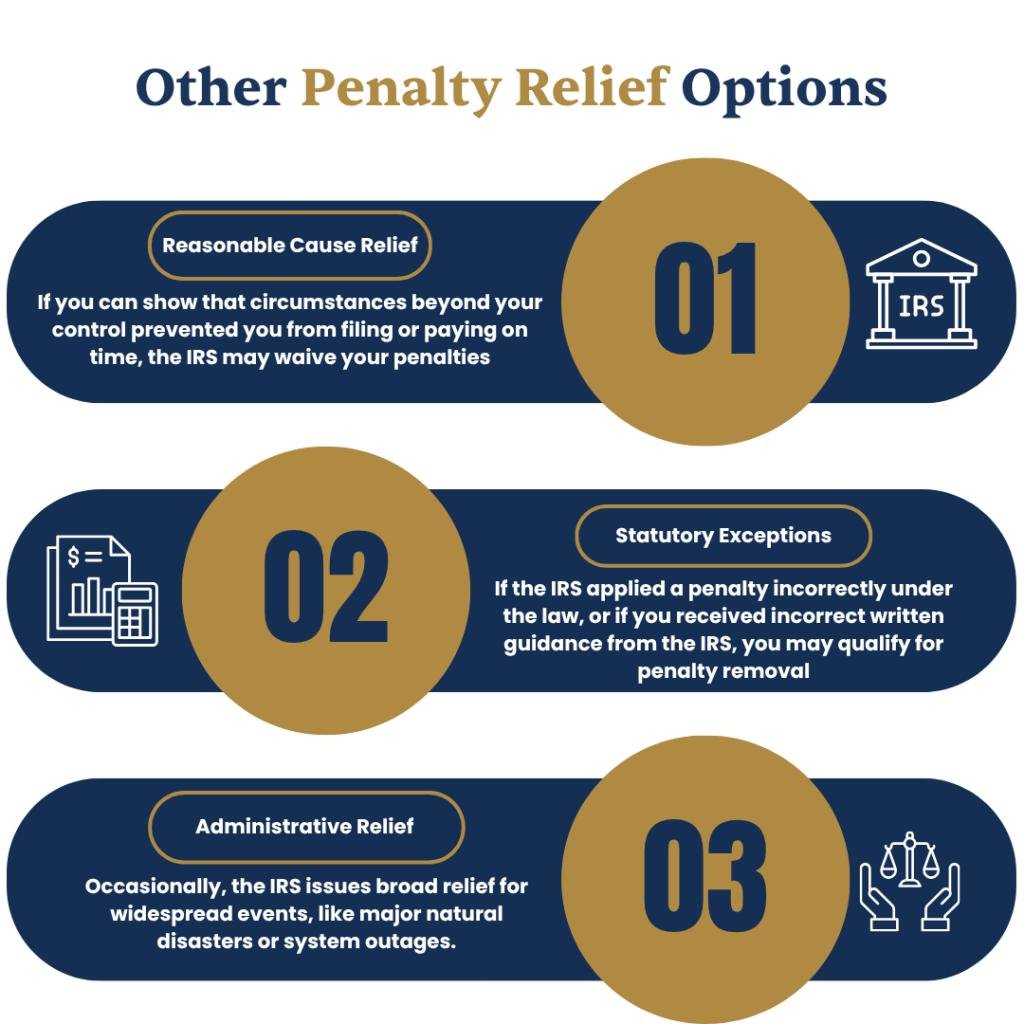
Reasonable Cause Relief
If you don’t qualify for first-time relief, or you want to preserve it, you can request abatement based on reasonable cause. The IRS grants this when you used ordinary business care and prudence but still couldn’t comply. Common examples include:
- Serious illness, hospitalization, or death in the immediate family
- Fire, flood, or other disaster that destroyed records
- Inability to obtain records despite good-faith efforts
- Reliance on incorrect advice from a tax professional in certain situations
Strong reasonable cause requests include a clear timeline, supporting documents (medical records, insurance claims, death certificates), and an explanation of how you fixed the problem once the circumstances ended. Note that “I forgot” or “I didn’t have the money” rarely qualifies on its own.
Statutory Exception
If you relied on incorrect written advice from the IRS itself, you may be able to have the penalty removed under a statutory exception. You’ll need a copy of your written request and the IRS’s written response.
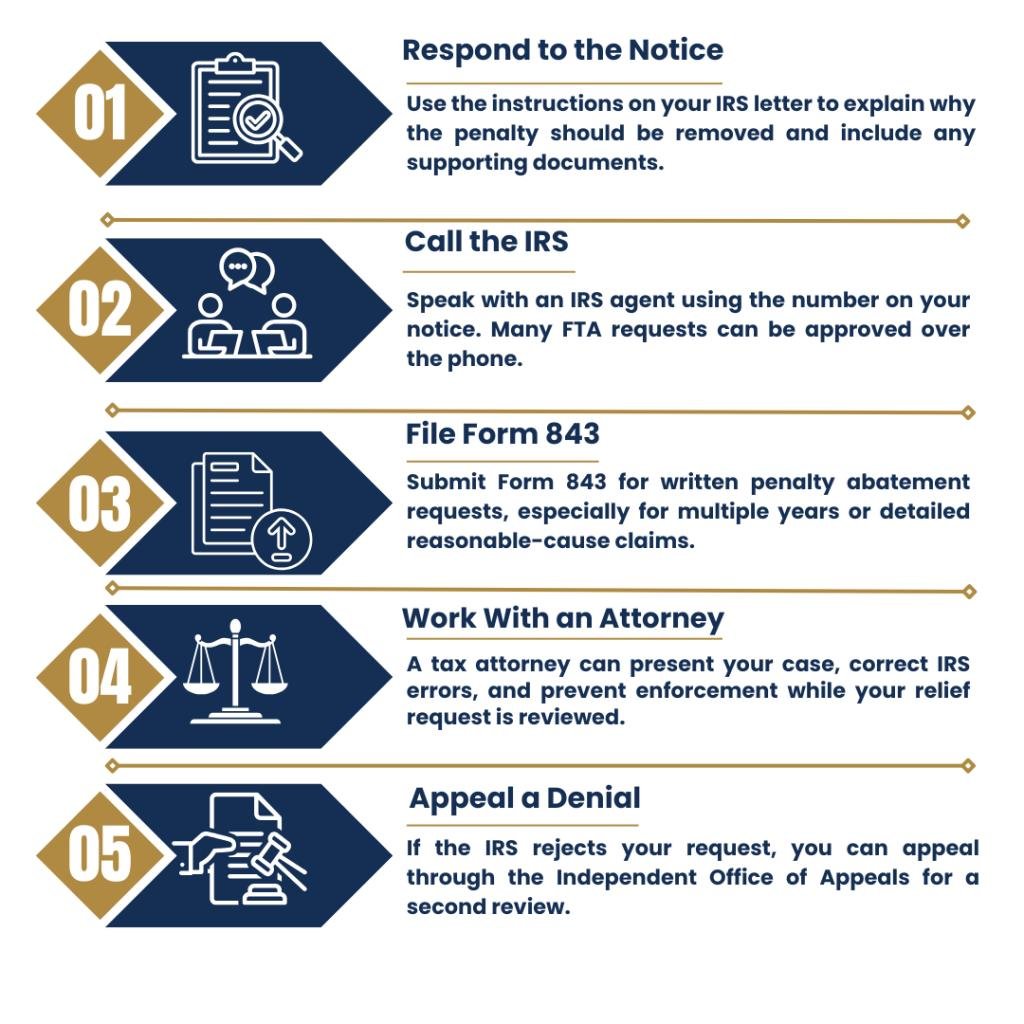
Step 5: Submit Your Abatement Request
You can request penalty abatement in several ways:
- By phone: call the number on your notice. First-time relief can often be granted during the call.
- In writing: respond to the notice with a letter explaining the grounds for relief.
- Using Form 843: file Form 843, Claim for Refund and Request for Abatement, especially for reasonable cause requests or when you’ve already paid the penalty and want a refund.
Keep copies of everything you send. If your request is denied, you generally have the right to appeal through the IRS Independent Office of Appeals.
Offshore Income, FBAR Penalties, and Voluntary Disclosure
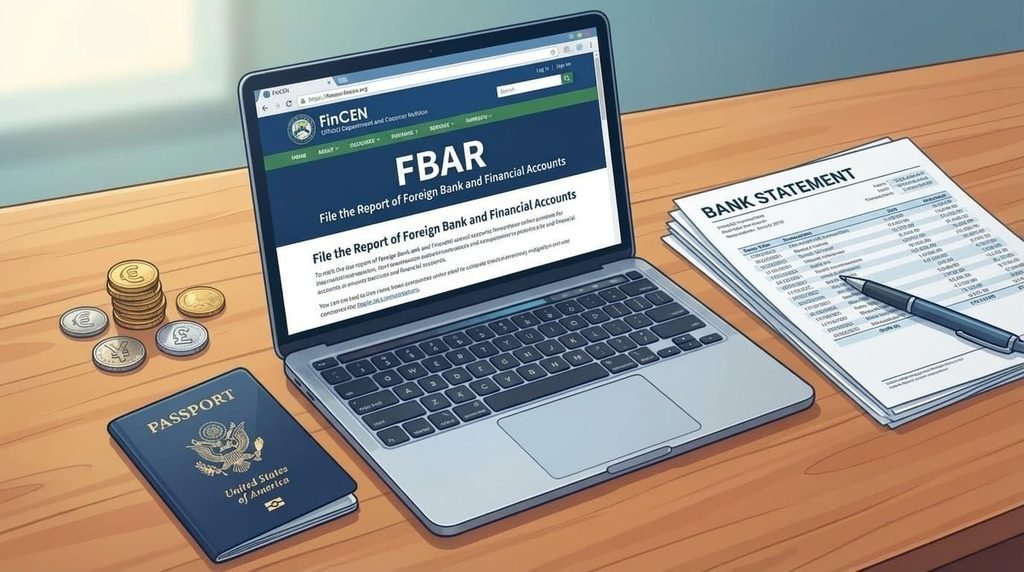
Penalties tied to foreign accounts follow different rules and can be far more serious. If you had more than $10,000 total in foreign financial accounts at any point during the year, you may have been required to file an FBAR (FinCEN Form 114). Missed FBARs can carry steep penalties, even for non-willful violations.
The options for fixing offshore income disclosure problems have changed:
- The Offshore Voluntary Disclosure Program (OVDP) closed in 2018.
- The IRS removed its Delinquent FBAR Submission Procedures on July 1, 2026, so late FBARs no longer come with a published no-penalty assurance.
- The Streamlined Filing Compliance Procedures remain available for taxpayers who can certify their failure was non-willful.
- The IRS Criminal Investigation Voluntary Disclosure Practice is the path for taxpayers whose conduct may have been willful.
Because a wrong certification can create serious exposure, offshore issues are a strong case for professional guidance before you file anything.
Understanding Tax Debt Payment Options After Penalty Relief
Penalty abatement lowers your balance, but you may still owe tax. Common tax debt payment options include:
- Installment agreements: monthly payment plans, many of which can be set up online
- Offer in Compromise: settling for less than the full amount if you qualify based on ability to pay
- Currently Not Collectible status: a temporary pause on collection during financial hardship
Acting early matters. Once the IRS issues a final notice of intent to levy, it can seize bank accounts or garnish wages. If that has already happened, look for IRS wage garnishment and tax levy help right away. Levies can often be released once you set up an agreement.
When to Seek Professional IRS Tax Resolution Help
You can request first-time relief on your own. But professional IRS tax resolution support is worth considering when:
- Penalties are large or span multiple years
- You’re relying on reasonable cause and need a well-documented case
- You face a levy, lien, or wage garnishment
- You have unreported foreign accounts or offshore income
- A previous abatement request was denied
A qualified representative can talk with the IRS for you, choose the strongest relief path, and coordinate penalty relief with a payment plan.
Mistakes to Avoid When Requesting Penalty Abatement
- Ignoring the notice. Deadlines protect your appeal rights.
- Paying without checking for relief. You can still request a refund later, but it’s easier to address it upfront.
- Using first-time relief when reasonable cause applies. Under the old system, saving FTA could protect you in a future year.
- Sending vague explanations. Specific dates and documents carry weight.
- Staying out of compliance. Unfiled returns or missed current payments can sink an otherwise valid request.
- Filing offshore disclosures without advice. The wrong program can make matters worse.
Frequently Asked Questions
Will the IRS really forgive tax penalties?
Yes. The IRS removes penalties for taxpayers who qualify for first-time relief, the new Automatic Exemption from Penalty, reasonable cause, or a statutory exception. Relief isn’t guaranteed, but many qualifying taxpayers never ask.
How do I request first-time penalty abatement?
Call the number on your notice, send a written request, or file Form 843. For eligible returns due on or after January 1, 2027, the IRS plans to apply relief automatically, but you should still confirm it appears on your notice or transcript.
Does penalty abatement remove interest?
Not directly. Interest on the underlying tax generally stays, but interest charged on the abated penalty is removed along with it.
What qualifies as reasonable cause for the IRS?
Events outside your control that prevented timely compliance despite ordinary care, such as serious illness, a death in the family, natural disasters, or the inability to get records.
Can I get FBAR penalties waived?
Possibly. The Streamlined Filing Compliance Procedures may limit or eliminate penalties for non-willful taxpayers. Since the Delinquent FBAR Submission Procedures ended in 2026, get professional advice before filing late FBARs.
Take the Next Step to Resolve IRS Tax Problems
Penalties can make a manageable tax bill feel overwhelming, but you have options. Read your notice, check your records, file what’s missing, and choose the right path to relief. Knowing how to resolve IRS tax problems starts with a clear picture of where you stand.

If you’d like an experienced team in your corner, Legacy Tax & Resolution Services can review your notices, identify penalty relief opportunities, and build a plan that fits your situation. Request a free initial consultation at legacytaxresolutionservices.com or call 800-829-7483 today.