

Opening an IRS notice and seeing penalties stacked on top of the tax you already owe is stressful. Maybe you filed late after a hard year, missed a payment, or didn’t realize a form was required. Whatever happened, the worst thing you can do is set the letter aside and hope it goes away. Learning how to resolve IRS tax problems starts with an encouraging fact: many IRS penalties can be reduced or removed entirely through a process called penalty abatement.
The IRS forgives penalties more often than most people expect, as long as you qualify and ask the right way. More and more, eligible relief is applied automatically. This guide covers what your notice means, your main abatement options (including reasonable cause, first-time relief, and offshore disclosure programs), and when professional IRS tax resolution help makes sense.
What an IRS Penalty Notice Means
A penalty notice is a formal statement that the IRS has added charges to your account. It isn’t a court judgment, and it isn’t the end of the conversation. The notice should list the tax year, the type of penalty, the amount, and a deadline to respond.
The most common penalties include:
- Failure to file: 5% of the unpaid tax for each month or part of a month the return is late, up to 25%.
- Failure to pay: 0.5% of the unpaid tax per month, up to 25%.
- Accuracy-related: generally 20% of an underpayment caused by negligence or a substantial understatement.
- Failure to deposit: for businesses that don’t deposit payroll taxes on time.
- Estimated tax: for self-employed taxpayers who underpay their quarterly estimates.
Interest also builds on unpaid tax and on most penalties. When a penalty is abated, the interest charged on that penalty is generally removed too, which is one more reason to act quickly. If you need IRS tax notice help, start by circling the response deadline printed on the letter.
Step 1: Review Your Tax Records and IRS Transcripts
Before you request relief, confirm the facts. Penalties are sometimes based on incomplete IRS records, such as a payment applied to the wrong year or a return the IRS never processed.
- Compare the notice to your copy of the return and your payment confirmations.
- Pull your account transcripts through your IRS Online Account to see every assessment, payment, and penalty by year.
- Check whether a penalty has already been removed. Under the IRS’s new automatic relief program, some eligible penalties now come off without a request.
- Gather documents for anything that kept you from filing or paying, such as medical records, insurance claims, or disaster notices.
Step 2: File Any Missing Returns
The IRS generally won’t grant penalty relief while you’re out of compliance. Every required return should be filed, even if you can’t pay the balance yet. Filing also stops the failure-to-file penalty from growing, and that penalty is typically much larger than the failure-to-pay penalty.
If you have several years of unfiled returns, consider having a professional rebuild your income from IRS wage and income transcripts so the returns are accurate the first time.
Step 3: Understand Your Penalty Abatement Options
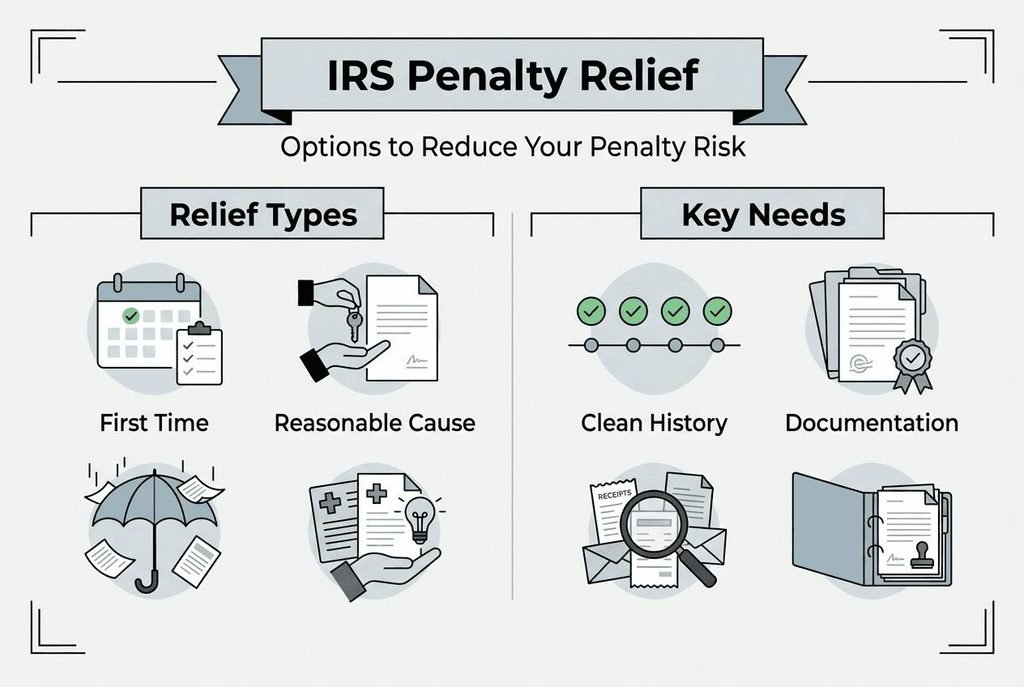
There are several paths to IRS penalty forgiveness. The right one depends on your compliance history and why the penalty happened.
Automatic Relief and First-Time Abatement
For years, First Time Abate (FTA) was the most widely used form of relief. It removes failure-to-file, failure-to-pay, and failure-to-deposit penalties for taxpayers with a clean three-year compliance history, but you had to ask for it.
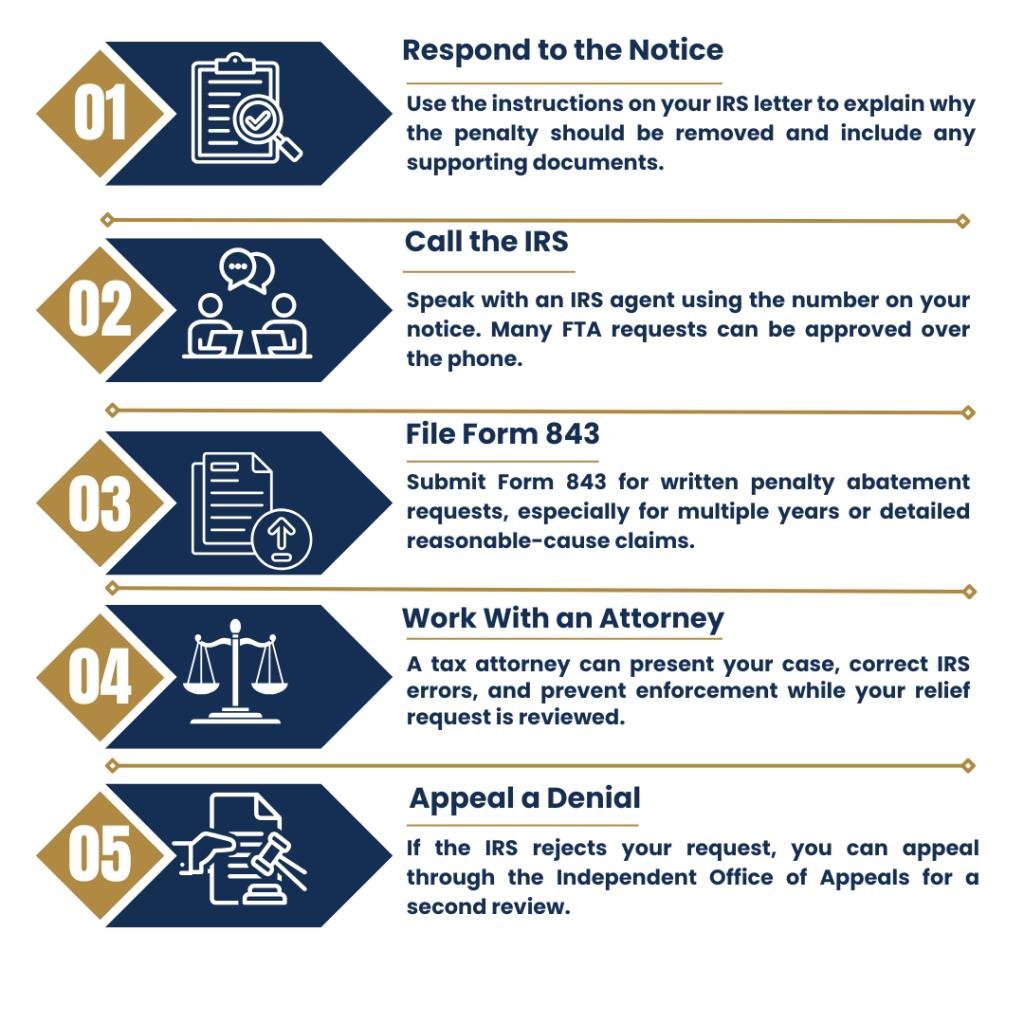
That’s changing. In July 2026, the IRS announced the Automatic Exemption from Penalty (AEP) program, which applies relief automatically to eligible taxpayers starting in summer 2026. AEP fully replaces FTA for eligible returns originally due on or after January 1, 2027. During the transition, some qualifying taxpayers may still receive penalty notices. In that case, you can still request FTA by phone or in writing.
Automatic relief doesn’t erase the underlying tax or interest, and it doesn’t cover every penalty. Accuracy-related penalties and many international information return penalties need a different path.
Reasonable Cause Relief
If you don’t qualify for automatic or first-time relief, reasonable cause is the next option. The IRS may remove a penalty if you show you used ordinary business care and prudence but still couldn’t comply because of circumstances beyond your control. Situations the IRS may accept include:
- Serious illness, incapacity, or death of the taxpayer or an immediate family member
- Fire, natural disaster, or another casualty
- Inability to obtain necessary records despite reasonable efforts
- Reliance on incorrect written advice from the IRS
Forgetfulness, a busy schedule, or a lack of funds usually won’t qualify on their own. Timing matters too. You’ll need to show how the event lines up with the missed deadline and that you complied as soon as you reasonably could.
You can make an abatement request by calling the number on your notice, responding in writing, or filing Form 843, Claim for Refund and Request for Abatement. For larger penalties, a clear, well-documented letter is usually more persuasive than a phone call.
IRS Errors and Statutory Exceptions
Some penalties come off because the IRS made a mistake, such as a processing delay or incorrect written guidance. If your records show the penalty was assessed in error, the fix may be a correction rather than a request for forgiveness.
Offshore Income, FBAR Penalties, and Voluntary Disclosure
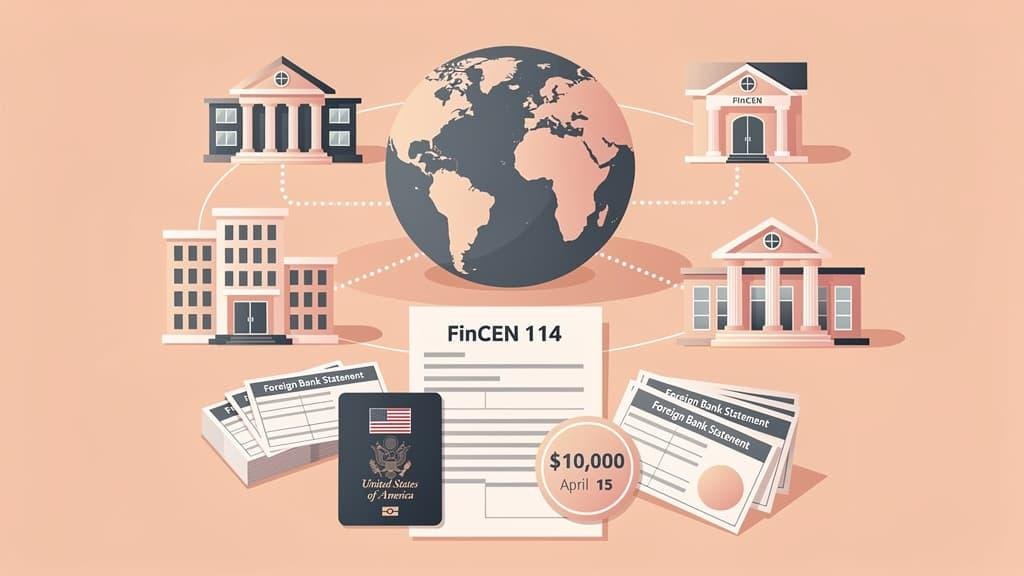
If your foreign bank or financial accounts totaled more than $10,000 at any point during the year, you may need to file an FBAR (FinCEN Form 114). FBAR penalties are separate from income tax penalties and can be severe. In 2026, non-willful violations can reach $16,536 per report, and willful violations can reach the greater of $165,353 or 50% of the account balance.
The Offshore Voluntary Disclosure Program (OVDP) closed in 2018, but you still have ways to disclose offshore income:
- Streamlined Filing Compliance Procedures for taxpayers whose failure to report was non-willful
- The IRS Criminal Investigation Voluntary Disclosure Practice for taxpayers whose conduct may have been willful
- Reasonable cause statements for certain late FBARs and international information returns
IRS guidance in this area shifted in 2026, and the right path depends heavily on your facts. Because the stakes are high, talk to a professional before filing anything.
Step 4: Pair Penalty Relief With Tax Debt Payment Options
Removing penalties lowers your balance, but you may still owe tax and interest. The IRS offers several tax debt payment options:
- Short-term payment plans of up to 180 days
- Long-term installment agreements with monthly payments
- An Offer in Compromise, which may settle the debt for less than the full amount if you qualify
- Currently Not Collectible status if paying would cause financial hardship
A penalty abatement request and a payment plan can often move forward at the same time. If you filed on time, the failure-to-pay rate also drops while an approved installment agreement is in place.
How to Resolve IRS Tax Problems With Professional Help
Many taxpayers handle a simple first-time penalty on their own. Others benefit from experienced IRS tax resolution support. Consider professional help when:
- Penalties span multiple years or add up to thousands of dollars
- Your abatement request was denied and you’re considering an appeal
- You have unfiled returns or need help with back taxes
- You’ve received a final notice of intent to levy or need IRS wage garnishment and tax levy help
- You have foreign accounts, offshore income, or FBAR exposure
A tax professional can review your transcripts, find every penalty that may qualify, build a reasonable cause argument around IRS standards, and handle communication with the IRS for you.

Mistakes to Avoid
- Ignoring notices. Deadlines protect your appeal rights, and collection can escalate to liens and levies.
- Paying and never asking. You can request abatement after paying and receive a refund if it’s granted.
- Vague explanations. “I was busy” rarely works. Specific dates and documents do.
- Missing the refund window. Refund claims for paid penalties generally must be filed within three years of filing the return or two years of payment, whichever is later.
- Assuming automatic relief was applied. Always check your notice and transcript.
- Filing offshore disclosures without advice. Choosing the wrong program can increase your exposure.
Frequently Asked Questions
Can the IRS really forgive penalties?
Yes. The IRS can remove many penalties through automatic relief, first-time abatement, reasonable cause, or correction of IRS errors. You still owe the underlying tax, but abatement can significantly reduce your balance.
What is IRS first-time penalty abatement?
First Time Abate removes failure-to-file, failure-to-pay, and failure-to-deposit penalties for taxpayers with a clean three-year history. It is being replaced by the Automatic Exemption from Penalty program, which applies relief to eligible returns without a request.
How do I write a penalty abatement request letter?
Include your name, taxpayer ID, the tax year, the notice number, and the penalty you want removed. Explain what happened, when it happened, how it kept you from complying, and when you fixed the problem. Attach supporting documents.
How long does penalty abatement take?
Simple phone requests may be resolved on the call. Written requests and Form 843 claims often take several months, depending on IRS workloads.
What if my abatement request is denied?
You can generally appeal to the IRS Independent Office of Appeals. The denial letter explains your appeal rights and deadlines.
Take the First Step Toward Penalty Relief
Penalties can make a manageable tax bill feel overwhelming, but they’re often negotiable. Knowing how to resolve IRS tax problems comes down to a few steps: read the notice, verify your records, get compliant, and pursue the right abatement and payment options.
If you’re not sure which relief you qualify for, or penalties are piling up alongside back taxes, liens, or levies, Legacy Tax & Resolution Services can help. We work with individuals, self-employed taxpayers, and small-business owners nationwide. Request your free initial consultation at www.legacytaxresolutionservices.com or call 800-829-7483 to review your situation and your next steps.